A little after 5 p.m. on October 13, 2022, Raleigh-Wake Emergency Communications received a call that a victim had been shot in the Hedingham subdivision in northeastern Raleigh. The neighborhood bordered the Neuse River Greenway Trail, which is part of the Mountains-to-Sea Trail. The caller reported the shooter was dressed in camouflage and carrying a long gun and backpack. By 5:55 p.m., members of the Raleigh Police Department had arrived on the scene and statements on Twitter warned of an active shooting in the neighborhood. Police advised residents near Osprey Cove Drive and Bay Harbor Drive to remain in their homes.
The nightmare continued. At 6:49 p.m., the police issued another warning, telling people in the area of McConnell Oliver Drive, Tarheel Club Road, and Old Milburnie Road to remain indoors. Drivers were told to avoid the area altogether and seek alternate routes.
The Victims
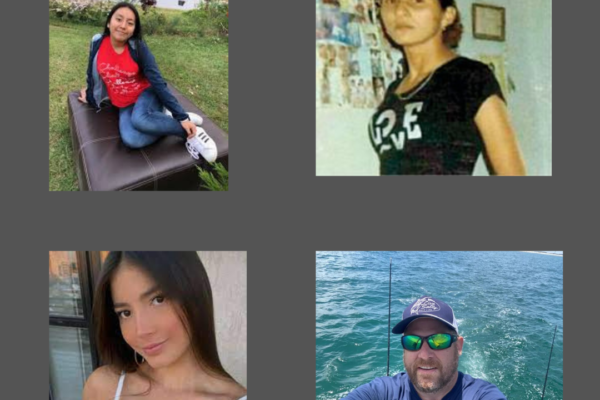
At 8 p.m. Raleigh police announced they had a suspect in the shooting contained in a residence in the area. By 9 p.m. Raleigh. Mayor Mary-Ann Baldwin reported that five people had been killed in the shooting, including an off-duty Raleigh police officer. Two other people were taken to Wake-Med, and another police officer received non-life-threatening injuries. At 9:37 p.m. the Raleigh Police Department announced through a Twitter post that a suspect was in custody. By early the next morning, October 14, police began a search of a home on Sahalee Way in the Hedinham neighborhood. Mayor Baldwin released the names of the five people killed: James Thompson, 16, Nicole Connors, 52, Susan Karnatz, 49, Mary Marshall, 34 and Gabriel Torres, 29.
James Thompson died in his home. Nicole Connors and her dog were killed as they returned home from a walk. Sue Karnatz was 5 miles into a 7-mile run when she was shot. Mary Marshall was also out walking on the greenway. Officer Gabriel Torres, who lived in the Hedinham neighborhood, was on his way to work at the Raleigh Police Department when he crossed paths with the shooter.
By 2:15 that afternoon the Raleigh News & Observer received news that the shooting suspect was 15-year-old Austin Thompson, and victim James Thompson had been his older brother. Police believed Austin, a sophomore at Knighdale High School, first murdered his brother and then headed out into the neighborhood to continue searching for victims. Austin was in critical condition at WakeMed after a standoff with police the evening before.
The crime scene spanned two miles, from the Thompson home in Hedinham to the Neuse River Greenway Trail.
The News and Observer released radio exchanges from the police department that shared what happened when police approached Austin Thompson in an outbuilding located in an area off McConnell Oliver Drive shortly after 7 p.m. on October 13. The assailant fired multiple rounds at police from inside the barn. One officer went down with a gunshot to the knee. They used drone and robot technology to keep themselves safe while assessing the threat of the situation. A robot separated Austin from a backpack full of potentially lethal weapons he had with him. When they reached Austin inside the barn around 9:30 p.m., he had a severe head injury, which police later learned was self inflicted.
Who Was Austin Thompson?
Austin Thompson had lived with his brother and father, who worked as a handyman, at the home in the Hedinham neighborhood. In the days following the shooting, police declined to discuss a possible motive in the mass shooting. Neighbors told the local media that they had witnessed unusual behavior from Austin. One said he used to see the young man at 4:30 or 5 a.m. with his backpack. The neighbor thought it was strange because the buses to the local high school didn’t start running until 7 a.m.
Another neighbor said her children told her the Thompson brothers kept to themselves on the bus. They didn’t converse much with anyone but each other. But again, no one thought it was unusual.
The husband of Nicole Connors said the Thompson had lived two houses away, and he would sometimes chat with Alan Thompson about college football. He’d wave to the two boys, and sometimes they waved back and sometimes they didn’t. He didn’t think anything of it though. They were being teenagers.
A classmate of Austin Thompson’s was shocked when he learned about the shooting. He said he found Austin personable and thought he might join the track team because he liked to run. The classmate said he was friendly to everyone and didn’t seem like a mean person at all.
In the days following the shooting spree, Austin’s parents, Alan and Elise Thompson, released a statement to the public. It read:
“Our son Austin inflicted immeasurable pain on the Raleigh community, and we are overcome with grief for the innocent lives lost.” They said they planned to fully cooperate with law enforcement to try and understand what led their son to murder so many people that October afternoon, but they also had many unanswered questions.
The statement continued on:
“There were never any indications or warning signs that Austin was capable of doing anything like this.”
At the time of the shootings, Austin’s parents were separated and the boys were living with Alan. The couple had discussed joint custody with their sons.
The Saturday after the shooting, the Hedingham neighborhood was scheduled to hold an annual fall festival. Instead, residents gathered at a local park to remember the victims lost. Neighborhood resident Tricia Preston led the community in six separate moments of silence for the five people killed and for the two injured victims: Officer Casey Joseph Clark and Marcille Gardner. She shared details of the victim’s lives. Officer Torres had left behind a 2-year-old daughter. James Thompson had been a high school student. Nicole Connors had enjoyed going to the movies with her husband. Susan Karnatz was a dedicated runner. Mary Marshall had been planning her wedding. The group later moved to the front of Beacon Baptist Church in East Raleigh for another memorial and prayers and reflection offered by local faith leaders.
On October 20, the family and friends of 16-year-old James Thompson laid him to rest at a memorial service at Trinity Baptist Church in Raleigh. The senior pastor, Dr. Jeff Roberts, shared that James had been attending the church since his mother started taking him in the 2nd grade.
The pastor addressed the horrific shooting and the questions that still surrounded it by saying:
“In these moments we try to make sense of what does not make sense, we try to comprehend that which is incomprehensible. We have all kinds of questions. Normal questions. Because we believe if we could just get some answers to some questions, we would be able to somehow process that which makes no sense to us.”
A Traumatic Brain Injury Results in Memory Loss
Austin Thompson remained hospitalized for his head injury for three weeks before being moved to another facility to await sentencing.
Seven months after the murders, the state released the autopsy reports for the five people killed by Austin Thompson.
James Thompson died of a gunshot wound to the head, and had 57 stab wounds to the neck.
Susan Karnatz died from six shotgun wounds to various parts of her body., including her head and neck.
Nicole Connors, who was sitting on her porch, died of at least 34 gunshot wounds. The bullets injured her spine, ribs, left humerus, heart, lung, diaphragm, liver, stomach, spleen and pancreas.
Mary Marshall was on the greenway looking for a lost dog when she died of multiple gunshot wounds to her head, neck, and shoulders.
Gabriel Torres was likely attacked by Austin Thompson before being shot. He suffered blunt force trauma to his left elbow and right knee, involving glass. He died of gunshot wounds to his upper chest, right side of his neck, right shoulder and left hand.
A Father Accepts Responsibility Improper Gun Storage
In September of 2024, Alan Thompson, age 61, pleaded guilty to the misdemeanor charge of improperly storing a handgun that authorities said was found with his son after the shootings. He received a 45-day suspended jail sentence and a year of unsupervised probation. Alan had kept the loaded 9 mm handgun in an unlocked box on a bedside table.
In January of this year, Austin Thompson pleaded guilty to five counts of murder, two counts of attempted murder, two counts of assault with a deadly weapon with intent to kill and one count of assault with a firearm and a law enforcement officer.
Austin used a shotgun, a handgun, and a large hunting knife during the rampage.
Austin Thompson’s Defense
Austin Thompson’s defense team presented the theory that the young man’s genetic background could have inhibited his ability to process medication, specifically one for acne that he was taking at the time of the shooting. Dr. Maher Noureddine, a forensic DNA consultant, testified that he examined Austin’s genetic background and found that Austin had inherited two copies of a bad gene from his parents, which would make metabolizing certain components harder. He said Austin harbored a genetic deficiency in processing some proteins. But for processing medications, such as the one for acne called minocycline, “that needed more research.” The doctor went on to testify, “What this result says is that he is unable to process medicine compared to a completely normal individual. Thompson can process some medicines fine, but others not so well.”
Dr. Noureddine said minocycline is unique because it is not easily cleared by the body through circulation and can build up in fat cells and in the brain and affect the central nervous system. He said there are some published psychiatric side effects to minocycline, including invoking feelings of depersonalization.
However, a children’s dermatologist with UNC Health, Dr. Dean Morrell, testified that he’s never heard of minocycline having psychiatric side effects from use, let alone leading to murder.
Austin graduated from high school while incarcerated at the Cumberland Juvenile Detention Center.
The Note Left Behind
During his sentencing hearing on February 4 of this year, prosecutors shared a note that Austin Thompson left behind on the day of the shooting. He wrote:
“The reason I did this is because I hate humans. They are destroying the planet/earth. Killed him at 4:20 about 5 minutes off maybe. He kept breathing so I stabbed him. Stopped breathing about 10-15 minutes later. I don’t have a goal. I’m not suicidal. Death is like sleep. That’s why I don’t care if I die. I was never bullied or anything. By dad. I don’t like you, Mom. Every other family member is good. Thanks Juan and DeAngelo for taking me hunting. I don’t want to die, but it is going to happen anyway. You were the best dad. I was never bullied in school either. Cops I killed James because he would get in my way. I killed James with a subsonic 22 I stole from Cabela’s.
The note went on to say, “I have no regrets. I’m not mental, either. I was sane when I did this.”
The state called a behavioral analyst from the FBI, Dr. Karie Gibson, to discuss the background, influences and emotional progression of mass shooters. She had not personally met with Austin Thompson prior to her testimony. She discussed her research on mass shooters, saying, “They focus on violent ideation, so that could be suicidal, homicidal, consumption of violent content online, consuming violent imagery—but overall, marinates in violence on that step of the pathway. She said it is common that if a mass shooter has knowledge and access to weapons, it can accelerate their violent plans. Earlier in the week, witnesses that included Austin’s parents testified that he spent hours a day playing a first-person shooter video game. He also had access to multiple firearms in his father’s homes, as well as experience using them while hunting.
Dr. Gibson shared key identifiers in someone who commits targeted violence: violent ideation, the researching and planning stages and the position of bystanders and family members.
What a Search History Revealed
Sergeant Robert Pike with the Raleigh Police Department shared Austin’s search history, which included more than 1,000 searches related to guns, bomb making materials, rapes, murders, school shootings, and photos of his high school. A search from January 4, 2020 asked what the worst mass shooting was in North Carolina history. Austin was 12 years old at the time of the search. He searched for pictures of dead bodies from the Pulse Nightclub shooting. He also searched “can juveniles get the death penalty” a month and half before the October 13 shooting.
His iPhone 11 cell phone data showed the exact route Austin took on the day of the mass shooting. Investigators shared the route in an interactive presentation in court.
At 4:20 p.m., he murdered James Thompson in their family home.
At 5:08 p.m., a security camera captured Nicole Connors and Marcille “Lynn” Garner walking past the suspect’s residence. At the same time, Austin exited the home. He shot both Nicole and Marcille. Nicole and her dog Sammy did not survive.
Witnesses took photos of Austin crossing a field in the neighborhood. Dressed in camouflage and carrying a long rife, he stood out on the suburban streets.
At 5:12 p.m. Austin shot Officer Torres while he was sitting in his vehicle.
At 5:15 p.m. he killed Mary Marshall on the Neuse River Greenway.
A short distance away Susan Karnatz was running on the trail. She was killed within seconds of Mary Marshall.
At 6:12 p.m., Austin was seen running into the woods near Tarheel Club Road. At 6:44 p.m. Officer Clark was shot while exchanging gunfire with Austin, who then backed himself into the shed.
At 9:36 p.m. Austin Thompson was taken into custody on McConnell Oliver Drive.
Employees from the Cumberland Juvenile Detention Center testified about Austin’s behavior at the facility. Darcie Ross said Austin achieved gold status within six weeks, earning incentives within the facility. A clinical and forensic psychologist, Dr. Jennifer Sapia, met with Austin in July of 2025.
She explained his brain injury caused significant disruption to his development. He had to re-learn basic skills as part of his recovery. At age 16, his IQ rose from 73 to 91, though he still has difficulty processing information.
She said, “He understands cognitively what has happened and has taken responsibility, understands he will go to prison for a long time, but it was adolescent magical thinking. He thinks of a future of being a dental hygienist but is not fully able to appreciate and put himself in that kind of future.”
On February 13 of this year, Wake County Judge Paul Rideway sentenced 18-year-old Austin Thompson to five consecutive life terms without the possibility of parole, ruling that the teen is among the rare juvenile offenders whose crimes demonstrate permanent and irreparable corruption. He also received consecutive prison terms of 157 to 201 months for the attempted murders of Lynn Garner and Casey Clark. Because he was a juvenile at the time of the crimes, he was not eligible for the death penalty.
The judge rejected the defense theory that Austin experienced a rare dissociative side effect from the acne medication minocycline. Judge Ridgeway said he did not find medical evidence to support the claim and explained that Austin’s conduct before, during, and after the attacks demonstrated deliberation and awareness.
Austin Thompson’s defense attorneys immediately filed a notice of appeal.