Margaret “Peg” Cuttino was born and raised in Sumter County, South Carolina. She was the daughter of South Carolina state senator James Cuttino, a democrat. Peg was 13 years old and an eighth grader at Alice Drive Junior High School. She played on the school’s varsity basketball team. Peg had grown up campaigning for her father and sang in her church’s youth choir. On December 18, 1970, she left her home to walk to the nearby Willow Drive School, intending to have lunch with her younger sister. She never made it to the school. Her parents, who had last seen her that morning when she left, reported her missing around 2:30 p.m. Peg was described as standing five feet two inches tall, weighing around 130 pounds, with brunette shoulder-length hair and blue eyes. She was wearing a blue blouse, white skirt, and polka dot sash.
Local police launched a search shortly after Peg was reported missing. The Sumter Sheriff’s Office and the South Carolina Highway patrol also got involved. The nearby Shaw Airforce Base provided a helicopter and several bloodhounds. At first, there was no evidence to suspect foul play. Then a few days into the search, the FBI got involved on the grounds that Peg could have been kidnapped. A ransom call never came, though.
While the search was ongoing, the local community came together and rallied around Peg’s family. Four Sumter County radio stations broadcast a prayer for the family, followed by 30 seconds of silence. Senator Cuttino stated that “Never in my wildest dreams could I have imagined such a response as this community has shown in a situation such as this.”
A $5,000 reward was offered for information on Peg’s disappearance and whereabouts. Even with this reward, the police were left with only one lead: that a classmate had seen Peg in the backseat of a beige 1964 Mercury Comet on the day she disappeared, driven by a man alongside another woman passenger.
A Horrifying Discovery
On December 30, two airmen, Captain Gregory Dorsey and Captain Paul Nowack, were riding motorcycles around 14 miles west of Sumter when they came across a deceased body. Specifically, the remains were near Orange Hill Church, about one mile up a dirt road off South Carolina Highway 261. The area was wet due to rain, and in a heavily wooded section of the Manchester State Forest. The body was buried under some leaves and small tree branches. At first the airmen thought they had come across a mannequin, but when they recognized the polka dot sash that had been mentioned in all the media outlets describing what Peg had been wearing, they knew they had likely found her body.
Sheriff I. Byrd Parnell identified the body as that of Margaret “Peg” Cuttino based on her clothing and physical description. He had known her personally. The site of her body’s discovery had to be secured by state and local law enforcement when curious people tried to enter the area.
Three pathologists from the Medical University of South Carolina were brought to the scene of the crime to perform a preliminary autopsy to determine cause of death. Peg’s body stayed at the scene until this was completed, and was taken to the university in Charleston several hours later for a full autopsy. The authorities investigated the area for clues to what had occurred, but they were impeded by the cold rain in the area.
The preliminary autopsy revealed that Peg had been beaten with a blunt weapon, possibly a tire iron, and then strangled with an item of clothing. The initial results did not reveal how long Peg had been dead prior to the discovery of the body. The authorities investigated weather reports to try and narrow down the timeframe.
The full autopsy revealed that Peg had been dead for at least five days prior to the discovery of her body, with law enforcement stating that she was most likely killed the same day she disappeared. The most sickening part was that she had also been repeatedly raped. One perplexing thing was that semen found in her body appeared to be fresh, which contradicted the theory that she had died not long after going missing.
Three months after the murder, a certain ex-con became a suspect in a slew of crimes. It was this man who would become the police’s main suspect in Peg Cuttino’s murder.
Who Was William “Junior” Pierce?
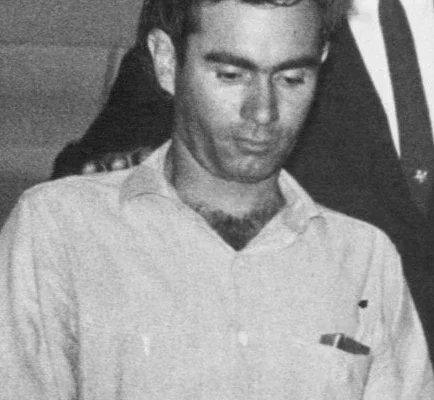
A 40-year-old man named William “Junior” Pierce was already an ex-convict when he was charged in three different murder cases. Pierce had served time for burglary, arson, attempted prison escape, and receiving stolen goods. He’d been paroled in the early 1970s despite a psychologist with the Georgia Department of Corrections saying the man had an unstable personality and could be considered “dangerous.” Deputy Sheriff Howard McCook of Swainsboro, Georgia stated that “We have reason to believe that three to five more cases of murder, along with as many as 10 other criminal charges may be involved.”
Just after Peg’s disappearance, Pierce, described in the media as an unmarried service station attendant, went on a crime spree in the state of Georgia. He robbed a service station and a store, shooting the employees in the process. He kidnapped 32-year-old Helen Wilcox in Hazlehurst, later raping and murdering her. Pierce led the police to the site of her body after his capture. Pierce also robbed a store in Baxley, killing the owner Vivian Miles and violently beating her five-year-old granddaughter. He chose isolated stores to rob in order to minimize witnesses. After killing Miles, he was then caught and confessed to multiple murder cases.
Pierce quickly became a suspect in the Cuttino case. Sheriff Parnell questioned Pierce, and managed to get a confession out of him. The sheriff and Sumter Police Chief L.W. Griffin told The Sumter Daily Item that they believed Peg had been picked up at gun point the day she disappeared somewhere between her home on Mason Croft Drive and Broad Street.
Pierce’s confession was a verbal one, and he never signed a written confession. This confession claimed Pierce had first spotted Peg at a hamburger stand talking to a group of other teenagers. Pierce had pulled a gun on one of the young men talking to Peg, after he said this teen pulled a tire chain out of his car. If all this had really happened like the confession claimed it did, wouldn’t these unidentified teens have come forward after Peg went missing? I would think anyone who witnessed Peg being coerced into a car by an older man would have said something, anything, especially with Peg’s story being shared all over the news.
Pierce was brought to Sumter for a trial in Peg Cuttino’s murder in the spring of 1973. His defense attorneys presented a slew of witnesses that seemed to exonerate the man. One was Pierce’s employer at the time of Peg’s murder, Ray Sconyers. Sconyers said on the day the 13-year-old disappeared, Pierce had been working at a portable building plant in Swainsboro, Georgia with 24 other workers. Sconyers said he saw Pierce punch his time card that morning and gave him his pay that afternoon. That night, Pierce attended a party with three other people, including a young woman with the last name of Blackman. They had all attended a party together.
Despite these witnesses for the defense, a jury of ten men and two women convicted Pierce of the murder in 1973.
Pierce later claimed that he was tortured into confessing. He said that he was burned with cigarettes and tortured with a cattle prod while in jail until he confessed to two murders. These murders were Peg Cuttino and Kathy Jo Anderson. The latter was a 17-year-old Lexington County High School Student and waitress. The charges against Pierce for Anderson’s murder were dropped due to a lack of evidence.
Pierce’s Mother Arrested
William Junior Pierce’s mother, Jewell White, fiercely advocated for her son during his trials and in May of 1973, police charged her with attempting to aid a prisoner escape after two handmade handcuff keys were found sewn into the clothing she brought her son to wear in court. No one paid the $5,000 bail a judge set for her so she served time in the county jail following her arrest. The Aiken Standard shared her some interesting quotes from Jewell, including, “My son’s a lover, not a killer,” and “I wish they’d bring out that one of those nine counts was stealing and carrying off on his back a 450-pound cow. Everything that happens, they blame on him.”
Many community members were skeptical of the guilty verdict. The most vocal being Mrs. S.G. Lenoir. Lenoir was a former postmistress, and stated that she had seen Peg in their general store the day after she went missing, with two other young men in a brownish yellow car. The Lenoirs had not been called to testify in Pierce’s trial, and the DAs were not aware of their testimony.
Mrs. Lenoir did end up testifying in a hearing for a new trial, but her testimony was refuted and Pierce was denied a new trial. Lenoir went so far as to take the matter to Washington D.C., where she attempted to get a federal investigation done on Peg Cuttino’s case.
Even with the skepticism, the case remained closed for several years, leaving the community wondering if they had truly brought Peg’s killer to justice. It wouldn’t be until 1977 that the debate restarted, when someone else confessed to the murder.
Pee Wee Gaskins Confesses
Donald “Pee Wee” Gaskins was another serial killer we’ve discussed in a recent episode. He had a history of crime before turning to murder, and killed more than a dozen people.
In 1997, Gaskin confessed to a “contract hit” on an unknown-to-him victim, ordered by a law enforcement official. Gaskins stated that “I didn’t know who it was I assassinated. Later, I found out for sure.”
Despite the existing doubt over the conviction of Pierce, the community was highly skeptical of Pee Wee Gaskin’s confession. Mrs. Lenoir was surprised by the confession, and said she had information that Gaskins had left Sumter on the day that the body was discovered. Regardless, Gaskin’s confession re-ignited the belief that Peg’s case should be reopened.
The authorities also refused to believe the confession. Gaskins was known to be a pathological liar, and he had some motives to lie about involvement in this case. Gaskins was also being tried for the murder of Silas Barnwell Yates at the time, and confessing to the Cuttino murder could have easily been an attempt to draw the jury’s attention away from that case.
During questioning, Assistant Third Circuit Solicitor Kenneth R. Young Jr pointed out that Gaskins might get more royalties by taking credit for Charles Manson’s murders. This was a reference to a book that was set to come out around this time detailing Gaskin’s murders. Gaskins did eventually explain the murder in his own autobiography.
After his testimony, Third Circuit Solicitor McLeod said “You hear Mr. Pee Wee Testify. He has but one ally–the devil himself.” adding “But I doubt if even the devil would taken him in.” Alongside Peg, he stated that he had killed a black girl via poisoning, and dumped her body in a drainage ditch, furthering the idea that he was lying to draw attention away from the case at hand.
A New Trial for Pierce?
Even with the clear doubt around Gaskin’s confession, Pierce’s attorney argued that the confession should warrant a new trial for his client. Even if Pierce got a new trial for this case, he was still a serial killer responsible for many murders, and would remain in prison regardless. Every appeal surrounding his many murder cases was rejected.
Gaskins was eventually executed after killing another inmate on death row with an explosive. He stated that he had killed 110 people, but law enforcement has managed to disprove many of these.
The Peg Cuttino case was a big deal. The young daughter of a state senator gets murdered, and nobody has any leads. The discovery of her murder rocked the community, and nobody could feel safe until the killer was brought to justice. Rep. Cuttino especially wanted to take action to ensure that this could never happen again.
He introduced a controversial bill into the state senate. The bill would have required all students in South Carolina to be fingerprinted. The intent was to aid law enforcement officers in investigations such as his daughter’s. The bill had to be withdrawn after it faced a slew of opposition. It would have been a constitutional overstep, but it’s easy to understand where Rep Cuttino was coming from.
Given the reaction to the murder, one can see how Pierce might be innocent. The investigation of Cuttino’s death had very few leads, and law enforcement was getting desperate. Enter Pierce, coming out of a crime spree and a potential connection to the murder. The community needed someone to be punished for the crime, and he fit the bill. Maybe he didn’t kill Peg Cuttino. The community seems to think he might not be the killer. The car he was driving at the time didn’t match the one Peg’s classmate said he saw her in. A murder weapon was never found and linked to Pierce. In 2019, the Netflix series “Mindhunter” featured a character based on William Pierce.
Pierce died in prison in May of 2020 at the age of 89. And he was found guilty of murdering many other people, so his time behind bars was justified. But questions about his involvement with Peg’s death linger. But unless someone comes forward with more information, which is highly unlikely given how old the case is, he will continue to be recognized as Peg’s killer.
Co-Writer for this episode is Mia Roberson.